Freezing Corn

For all of the things that I do in the summer, freezing corn is the biggest bang for the buck. It doesn’t take very long, it is reasonably priced and I get to enjoy beautiful sweet corn all year long.

I don’t grow corn myself as it is important to have a big “stand” to get good germination. Unlike other garden items, corn isn’t pollinated by the bees, but, rather, by the wind. Each silk goes to a specific kernel and needs to be pollinated individually. Corn also only takes six hours from when it is picked to turn from a sugar into a starch. So it’s important to process it early in the day.

I head down to my local organic farm after it opens. It’s about a twenty minute ride. I pick out about three dozen ears making sure that they were just picked. Once back home, I put some water on to boil and shuck the corn.
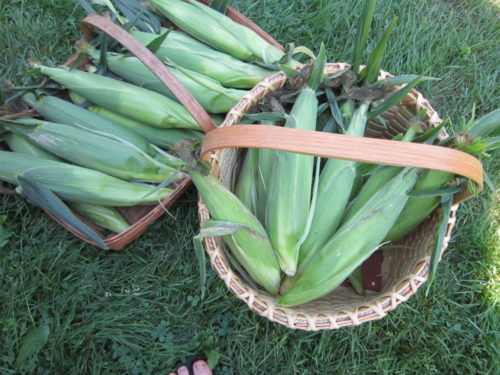
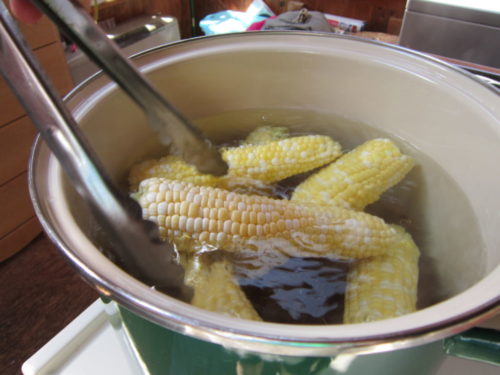
Placing six ears at a time in the water (you can also steam them if you prefer), I leave them in for three minutes.
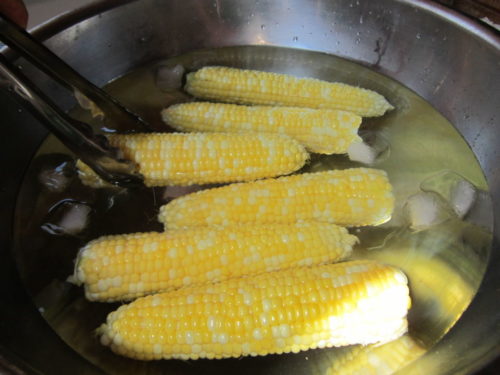
When they come out, they go into ice water to cool them down.
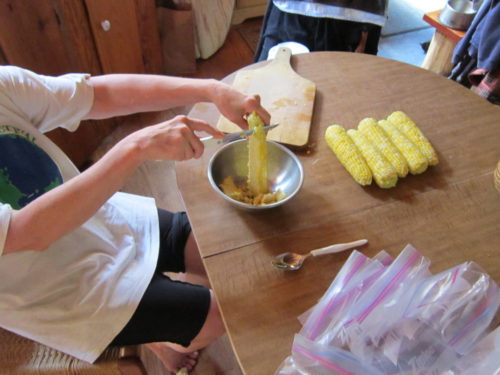
Cutting the corn off of the cobs, I put it into a bowl, then into freezer bags. I usually get about eight quarts from 2 ½ dozen ears (we eat the rest).
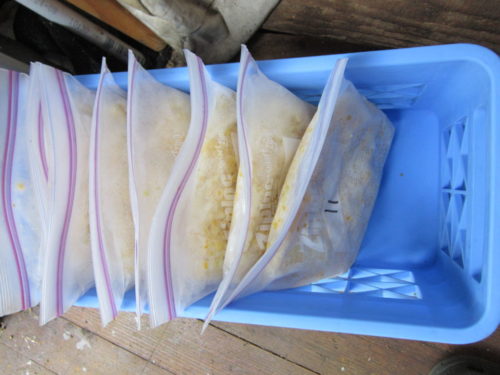
Labeling it with the year, into the freezer it goes.
This whole process takes me about two hours. So for very little time and money, I get to add sweet corn to soups and stews all winter long. I often use only a quarter or third of a bag at a time. It is well worth it.

Share

Similar Posts

  • Winter Sowing

    My friend, Jackie Caserta, told me that she had come across a very interesting idea about sowing seeds. A woman by the name of Trudi Davidoff claims that she sows many seeds outside in the winter. She says that they do better than any that she starts inside to later transplant into the garden. So…

    Share
  • Book Launch

    Welcome to the launch of my new book, “Celeste’s Garden Delights: Discover the Many Ways a Garden Can Nurture You.” It’s been a long time coming. From the day a year and a half ago when three different people asked me to write this book (the last one begging me) to the finished product, there…

    Share
  • Planting Potatoes

    Potatoes like to go into a cool soil. It is said that it is time to plant the potatoes when the dandelions begin to bloom. I like to “green” the potatoes for a week or two before planting. This is accomplished by placing them, right side up, in a bright, but not sunny, location. You…

    Share
  • Planting Mache

    Mache is an extremely nutritious green that can be added to salads during the winter months. Here, in the northeastern U.S. where it is cold (and frozen), mache can be grown in a sunny window inside. This vegetable actually likes the cold—it won’t germinate until temperatures stay consistently below 70 degrees F. So it is…

    Share
  • Cutworms

    Cutworms are my least favorite insect. I despise them more than mosquitoes, black flies or deer flies (a close second). They live under the soil during the day. Then they come up at night and take one bite of a plant right where that plant goes into the ground, killing it. Back down into the…

    Share
  • Turmeric

    Turmeric has long been used in Ayurvedic medicine. This traditional Indian methodology uses plants for most of its healing and turmeric is often prescribed. Some recent research is now indicating that this particular spice may have been the “gold” given to the Christ child along with myrrh and frankincense by the Wise Men. It is…

    Share

One Comment

  1. Have you ever tried a corn cutter instead of the knife to cut the corn. It is much fasting than using the knife.

Leave a Reply

Your email address will not be published. Required fields are marked *